
Early Clocks | Lee Borrett

Wonderfully elegant proportions with an ultra-narrow chapter ring and early rounded brass pillars. Attributed to the workshop of James Browne of Bristol, c.1642
English Civil War
Lantern Clock
c1642
Civil War
Lantern Clock, c1642
The Browne Family Workshop
James Browne of Bristol
Editor’s Note (July 2026)
The original version of this article attributed this remarkable Civil War lantern clock to Thomas Browne of Bristol, principally through comparison with the small group of Bristol lantern clocks first identified and studied by Sir George White. In English Lantern Clocks (1989), White published Thomas Browne’s only known signed lantern clock and explained how his examination of that clock enabled him to establish the Bristol origin of a group of previously anonymous lantern clocks sharing distinctive dial plates, engraving, frames and other constructional features. From this research he coined the description “the Bristol school of lantern clockmaking.”
More recently, Professor Jonathan Barry, historian of early modern Bristol and co-editor of the Bristol Record Society, has undertaken further research in the original Bristol civic records and generously shared his findings with me. His discoveries provide important new evidence concerning the Browne family and suggest that the early Civil War lantern clock illustrated here, previously attributed to Thomas Browne, most likely originated in the workshop of his father, James Browne.
Professor Barry’s research shows that James Browne was freed as a smith on 9 March 1625, having been apprenticed to Robert Northe. Thomas Browne was subsequently apprenticed to his father James and his mother Elizabeth on 12 October 1637 as a smith, before being admitted to the Freedom of the City by patrimony in November 1643, when he described himself as a watchmaker. As Thomas was therefore still serving his apprenticeship around 1642, the evidence suggests that the early Civil War lantern clock illustrated here most likely originated in James Browne’s workshop. The possibility that the young Thomas participated in its production while learning his craft is particularly intriguing, although this cannot presently be established from the documentary evidence.
This revised website edition therefore brings together Sir George White’s pioneering identification and study of the Bristol School with Professor Jonathan Barry’s new archival evidence concerning the Browne family. If the present interpretation is correct, the c.1642 Civil War lantern clock and Thomas Browne’s signed clock of about 1650 may represent successive stages in the development of the Browne family workshop—from James Browne during Thomas’s apprenticeship to the mature work of Thomas himself.
I am sincerely grateful to both Sir George White and Professor Jonathan Barry for the scholarship that has made this fuller understanding possible.
A Brief Account of the
English Civil War
(1642-1651)
With my interest in history and passion for collecting early lantern clocks, I have long been fascinated by the English Civil War of 1642–1651. It was one of the most momentous periods in British history, a conflict that ultimately culminated in the execution of King Charles I outside the Banqueting House at Whitehall on 30 January 1649.
Click image below to view stunning historic paintings from the Civil War period

Landseer Charles - the Eve of the Battle of Edge Hill 1642 - the first pitched battle of the English Civil War - British School - 19th Century. Image by Alamy.com
James Browne
Civil War Lantern Clock, c1642

Showing a side view of the attributed James Browne lantern clock c1642. Private collection, Photographed by Lee Borrett.
For the country’s clockmakers, these were undoubtedly difficult years. Brass and iron were in constant demand for the manufacture of cannon, weapons and ammunition for both the Royalist and Parliamentarian armies, making the production of domestic clocks increasingly challenging. Yet despite these hardships, a small number of lantern clocks continued to be made, and the exceptionally rare example illustrated here is one such survivor, dating from the opening years of the Civil War, around 1642.
Although unsigned, this clock was originally attributed to Thomas Browne of Bristol through comparison with his only known signed lantern clock and with the distinctive group of Bristol clocks first identified and studied by Sir George White. White’s examination of the signed Thomas Browne clock enabled him to recognise a related group of previously anonymous lantern clocks through their distinctive dial plates, engraving, frames and other constructional characteristics, forming the basis of what he termed the “Bristol school of lantern clockmaking.”
Recent archival research undertaken by Professor Jonathan Barry has, however, provided a fascinating new perspective. His examination of the original Bristol civic records shows that Thomas Browne was still serving his apprenticeship to his father during this period, making it far more likely that this remarkable Civil War lantern clock originated in the workshop of James Browne. Thomas was therefore learning his craft within the family workshop during the very period in which the clock appears to have been made.
If this interpretation is correct, the significance of the clock becomes even greater. Rather than representing one of Thomas Browne’s earliest surviving works, it may instead preserve the craftsmanship of the Browne family workshop itself, providing evidence for the transition from father to son during one of the most turbulent periods in English history and offering a fascinating insight into the earliest origins of the Bristol School of lantern clockmaking.
Among its many fascinating features is an ancient repair to the dial—a distinctive feature that may date back to the clock’s earliest years and one that I have come to think of as the clock’s own ‘Battle Scar’.

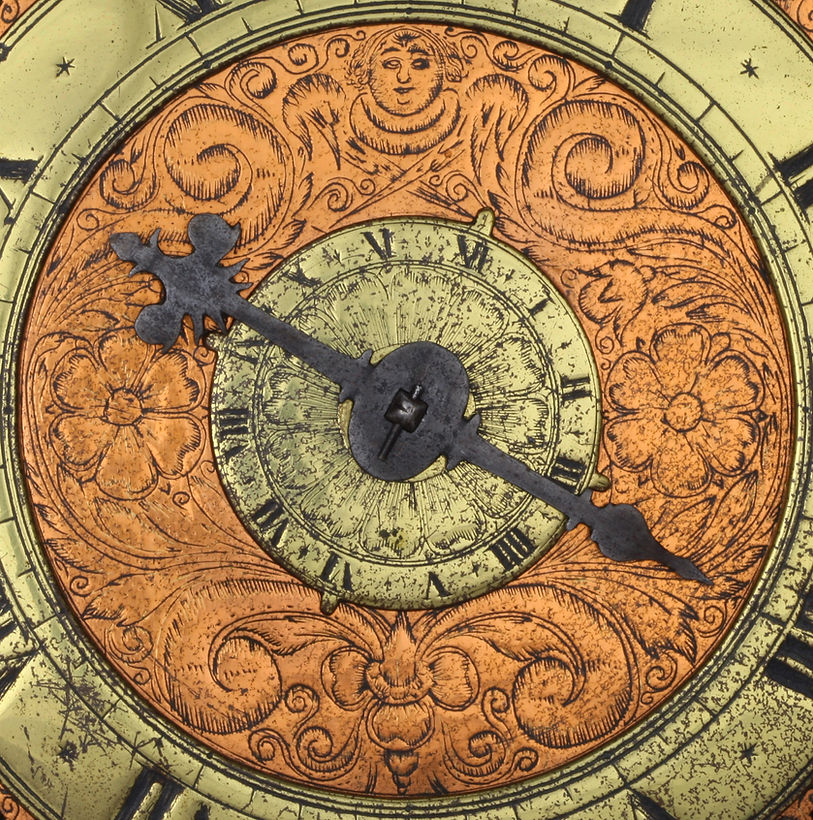
Above. A distinctive decorative feature found on a number of lantern clocks associated with the Bristol School is a small mask or cherubic-type head beneath XII. On this example the head has a ruff collar with crossed wings. The single iron hand is original. Private collection, Photographed by Lee Borrett.
Above. A fine early Civil War lantern clock attributed to James Browne of Bristol, c1642. Wonderfully elegant proportions with an ultra-narrow chapter ring and early rounded brass pillars. Private collection, Photographed by Lee Borrett.
Below. Side view with the doors and back plate removed. Private collection, Photographed by Lee Borrett.

Below. Other typical features of the Bristol School include an exceptionally slim waisted hammer spring and the method by which the chapter ring and dial are attached to the movement crossbar by a long upper lug, together with two dial feet pinned at the bottom of the dial. Private collection, Photographed by Lee Borrett.

Below. Close-up showing the original tapered arbours and brass wheel collets of the attributed James Browne workshop movement. Private collection, Photographed by Lee Borrett.

Below. View of the top plate. The clock retains its late seventeenth-century conversion from balance-wheel control to anchor escapement. From this angle the backcock conceals the holes where the original iron hoop was located. Private collection, Photographed by Lee Borrett.

Below. Another view of the top plate, showing the holes where the original iron hoop was located before the conversion to anchor escapement. Private collection, Photographed by Lee Borrett.

Below. Showing a rear view of the attributed James Browne Civil War lantern clock, c.1642. Private collection, Photographed by Lee Borrett.

The Browne Family Workshop
Recent archival research undertaken by Professor Jonathan Barry has provided important new insights into the early history of the Browne family and has significantly improved our understanding of the origins of Bristol clockmaking.
Thomas Browne was the son of James Browne, a Bristol blacksmith. Examination of the original Bristol civic records shows that Thomas was apprenticed to his father on 12 October 1637 as a smith before later becoming Free of the City by patrimony in November 1643, at which time he described himself as a watchmaker. This provides strong evidence that Thomas learned his trade within his father’s workshop, acquiring the practical skills associated with metalworking before emerging as a watchmaker in his own right.
These discoveries have important implications for the remarkable Civil War lantern clock illustrated here. Dating from around 1642, it was originally attributed to Thomas Browne on stylistic grounds. However, as Thomas was still serving his apprenticeship to his father during this period, the clock is now thought most likely to have originated in James Browne’s workshop. Thomas would therefore have been learning his craft within the family workshop at approximately the time this clock was made, although whether he personally participated in its construction cannot now be established.
If this interpretation is correct, the clock represents considerably more than an exceptionally rare Civil War survivor. It may preserve the work of the Browne family workshop at a pivotal moment in the development of Bristol clockmaking, when Thomas was serving his apprenticeship to his father and acquiring the skills that would later be expressed so clearly in his own signed work.
Dating from around 1642, the clock retains its original late seventeenth-century conversion from balance-wheel control to anchor escapement. During the same period the alarm work was removed and the clock was converted to Huygens’ endless-rope maintaining power. These alterations are entirely typical for a lantern clock of this age and form an important part of its long working history.
The clock is of wonderfully elegant proportions, with nicely turned rounded integral brass pillars and an exceptionally narrow chapter ring carrying small floating-star half-hour markers. The brass dial centre is beautifully engraved around the original alarm disc and incorporates an attractive cherubic head beneath XII, complete with ruff collar and crossed wings.
Comparison with Thomas Browne's only known signed lantern clock of around 1650 reveals striking similarities in engraving, construction and overall design. These shared characteristics strongly suggest continuity within the Browne family workshop, while also illustrating the subtle evolution of style between the earlier Civil War clock and Thomas Browne’s mature work.
One particularly interesting development within the group is the transition from the brass dial and rounded integral pillars of the earlier Civil War clock to the copper dial and square-based integral pillars seen on Thomas Browne’s signed clock of about 1650. The reason for this change remains uncertain. Availability of materials during the disrupted Civil War years may have played a part, although changing workshop practice or Thomas Browne’s own preference are equally possible explanations. What can be said with certainty is that the signed clock demonstrates that an engraved copper dial combined with square-based integral pillars had become part of Thomas Browne’s established workshop style by about 1650. Viewed alongside the earlier clock, these differences may help us trace the development of the Browne family workshop from the period of Thomas’s apprenticeship under James to Thomas’s mature work.
Showing a comparison between the signed Thomas Browne copper-dial lantern clock, c.1650, and the earlier brass-dial example, c.1642, now attributed to the workshop of James Browne. Note the striking similarities in the engraved dial style, narrow chapter rings and alarm discs Private collection, Photographed by Lee Borrett.

Below. The signed Thomas Browne clock, about 1650, with a copper dial and square-based integral pillars (left), beside the earlier Civil War lantern clock, c.1642, now thought most likely to have originated in the workshop of his father, James Browne, with rounded integral pillars and a brass dial (right). Together the two clocks may represent successive generations of one of Bristol’s earliest clockmaking families. Private collection, Photographed by Lee Borrett.

The Storming of Bristol
and the Browne Family Workshop
One of the most intriguing aspects of this remarkable Civil War lantern clock is the historical setting in which it was made.
Recent archival research by Professor Jonathan Barry has shown that Thomas Browne was apprenticed to his father, James Browne, on 12 October 1637. By the opening years of the English Civil War, Thomas was therefore already learning his trade within the Browne family workshop, acquiring the practical skills that would later establish him as one of Bristol’s earliest and most accomplished clockmakers.
The clock illustrated here is thought to date from around 1642, placing its manufacture during one of the most uncertain periods in Bristol’s history. At the time, the city was one of England’s principal west-coast ports and was regarded as being of immense strategic importance by both Royalists and Parliamentarians.
Only a year later, on 26 July 1643, Bristol witnessed one of the defining events of the Civil War. During the Storming of Bristol, Prince Rupert’s Royalist army launched a determined assault on the city, eventually forcing the Parliamentarian defenders to surrender after fierce fighting and heavy casualties on both sides.
It was against this backdrop of siege, military occupation and political upheaval that the Browne family lived and worked in Bristol. Although there is no evidence that either James or Thomas Browne played any direct part in these events, the disruption caused by war must inevitably have affected every craftsman living and working within the city. Brass and iron were important wartime materials required for the manufacture of cannon, weapons and ammunition, while trade and everyday life were inevitably affected by the demands and disruption of war.
Only a few months after Bristol had fallen to the Royalists, Thomas Browne became Free of the City in November 1643 by patrimony and described himself as a watchmaker. This important milestone formally established Thomas as a freeman of Bristol and provides the first documentary record in which he described himself as a watchmaker.
Seen in this historical context, the survival of the present lantern clock becomes even more remarkable. If it was indeed made within the Browne family workshop during these turbulent years, it represents not only one of the earliest surviving Bristol lantern clocks but also a tangible witness to one of the most dramatic periods in English history.

The Storming of Bristol. Image by Alamy.com
'Battle Scar'
one of the most intriguing features of this remarkable Civil War lantern clock is an ancient repair to a fracture in the dial at the 9 o’clock position. Close examination suggests that the repair was carried out very early in the clock’s working life. A small brass reinforcing plate was riveted to the reverse of the dial to stabilise the crack, while the front was carefully filled with wax in an attempt to disguise the damage.
Although the true cause of the fracture can never be known, several possibilities exist. It may simply have resulted from an accidental fall or careless handling during the clock’s long working life. Equally, it could represent a stress fracture associated with an imperfection in the brass casting or simply the stresses accumulated during the clock’s long working life.
Because this clock is now thought to have been made within the Browne family workshop during the opening years of the Civil War, it has become impossible for me not to wonder whether this ancient repair has a story of its own to tell.
Was the damage sustained many years later during the clock’s long working life, or did it occur much earlier, perhaps while the country itself was being torn apart by civil war? We shall almost certainly never know.
Whatever its origin, I have come to think of this early repair as the clock’s own ‘Battle Scar’. Whether that description is taken literally or simply as a reflection of the turbulent times through which it survived, the repair has become an important part of the clock’s story.
Rather than detracting from its significance, it adds to the character, authenticity and historical appeal of an extraordinary survivor that has now witnessed almost four centuries of English history.
If recent archival research is correct, this remarkable clock represents not only one of the earliest surviving Bristol lantern clocks, but also the craftsmanship of the Browne family workshop during the formative years of the Bristol School. Seen alongside Thomas Browne’s only known signed lantern clock of around 1650, it provides a fascinating glimpse into the transition from father to son and the beginnings of one of England’s earliest provincial traditions of clockmaking.

English Civil War
Lantern Clock
c1642
Above. Showing the early Civil War lantern clock, c.1642, now attributed to the workshop of James Browne of Bristol, complete with its ancient ‘Battle Scar’ at 9 o’clock. The two framed images depict King Charles I and Oliver Cromwell, both shown wearing armour. Private collection, Photographed by Lee Borrett.
Summary
For me, one of the greatest pleasures of owning an antique clock is that, if you are prepared to invest the time and effort researching its background, you can often be rewarded with some remarkably interesting discoveries. The clock illustrated here has certainly done that.
When I first began researching this remarkable Civil War lantern clock, it seemed to represent one of the earliest surviving works attributed to Thomas Browne of Bristol. Since then, however, further archival research undertaken by Professor Jonathan Barry has provided an important new perspective. His examination of the original Bristol civic records suggests that the clock most likely originated in the workshop of James Browne, while his son Thomas was serving his apprenticeship to his father.
From the day it was first made, during the opening years of the English Civil War, both the clock and its earliest owners lived through an uncertain and dangerous period. Homes were destroyed, civilians were caught up in the violence of war, men were continually pressed into the Royalist and Parliamentarian armies, while outbreaks of plague and other diseases claimed countless lives.
Now, almost four centuries later, this remarkable survivor continues to give immense pleasure, but for me it carries an even more powerful message. It stands not only as an exceptionally rare survivor from the opening years of the English Civil War, but also as what may prove to be one of the earliest surviving Bristol lantern clocks and an enduring testament to the craftsmanship of the Browne family workshop.
Seen alongside Thomas Browne’s only known signed lantern clock of around 1650, these two remarkable clocks may represent successive generations of the Browne family workshop, offering a fascinating glimpse into the beginnings of one of England’s earliest provincial schools of clockmaking.
Historical research is an evolving process. As further documentary evidence comes to light, our understanding of the Browne family and the origins of the Bristol School may continue to develop!
Acknowledgements
The preparation of this revised article has benefited greatly from the generosity, encouragement and scholarship of many people.
I am particularly grateful to Professor Jonathan Barry for so generously sharing the results of his continuing research into the original Bristol civic records. His careful examination of the archival evidence has provided important new evidence concerning James Browne, Thomas Browne and the early Browne family workshop, enabling this article to be revised in the light of the original Bristol civic records.
My sincere thanks are also due to Dr John Robey for his generous technical advice on early lantern clocks and for so willingly sharing his extensive knowledge of seventeenth-century movements and their development.
I would also like to thank my good friend Martin Gould, whose enthusiasm, encouragement and friendship have been a constant source of inspiration throughout my research into early English lantern clocks.
I am especially indebted to Sir George White, whose pioneering research established the modern study of the Bristol School of lantern clockmaking. After studying for many years a group of anonymous lantern clocks sharing related dial plates, engraved decoration, frames and other distinctive features, Sir George travelled to Washington specifically to examine Thomas Browne’s only known signed lantern clock in the collection of the late Norman Langmaid. The signed clock provided the crucial evidence linking the wider group to Bristol, and from this and his subsequent research Sir George coined the description “the Bristol school of lantern clockmaking”. His research into Thomas Browne and the early Bristol makers was published in his landmark book English Lantern Clocks in 1989 and provides the essential horological framework within which the present clock can now be considered.
I would also like to acknowledge the important published research of the late Brian Loomes, together with the work of A. J. Moore and W. F. Bruce, all of which has contributed greatly to our understanding of Bristol and early English lantern clockmaking. Historical understanding continually develops as surviving objects are reconsidered alongside documentary evidence, and Professor Jonathan Barry’s recent archival discoveries demonstrate how earlier scholarship can be extended and refined as new evidence comes to light.