
Early Clocks | Lee Borrett

Sundials
Before the arrival of mechanical clocks in England, sundials were the principal means of telling the time. Even after domestic clocks became established during the late sixteenth and early seventeenth centuries, sundials continued to play an essential role because the earliest clocks were seldom sufficiently accurate to keep reliable time for long periods. As a result, they were regularly reset by reference to a sundial.
Many lantern clockmakers are believed to have supplied their clocks with a small brass sundial, often referred to today as a ‘windowsill’ sundial. These were made either by the clockmaker himself, by a scientific instrument maker, or, for wealthier customers, by one of London’s highly skilled mathematical instrument makers.
Today these small brass sundials are fascinating historical objects in their own right and provide an important link between the history of timekeeping and the development of the earliest domestic clocks.
Edward Coolinge, dated 1625
London Sundial By
A

Signed E.C and dated 1625, this wonderfully interesting early small 'windowsill' sundial was made during one of the most historically important years in the history of the British Monarchy. Click here to see my full article which is shown alongside historic high quality paintings of the period. Private collection, Photographed by Lee Borrett.
Charles I, Period
Clockmakers Sundial, 1634

A
The wonderfully original, early 17th century brass sundial shown here is believed to have been made by a provincial clockmaker and has some nice early features including retaining its original, thin brass knife-edge gnomon with its original fringed northern supporting plate. Interestingly, the dial is dated 1634 and was made in the same year as when King Charles I,...... Click here to see my full article which is shown alongside historic high quality paintings of the period. Private collection, Photographed by Lee Borrett.
A
James I, Period
Clockmaker's Sundial, c1620

The superb, historically interesting small provincial clockmaker's brass sundial illustrated here was possibily made during the reign of King James I, in the early 1620s and is a very rare survivor. Click here to see my full article which is shown alongside historic high quality paintings of the period. Private collection, Photographed by Lee Borrett.
A
Charles I
Period Sundial By
William Letchford, Dated 1647

A wonderfully original King Charles I period provincial sundial made in 1647 by William Letchford of Ridley, Kent. Measuring just over 2.8 inches square, this small horizontal brass sundial (sometimes referred to as a ‘windowsill’ dial), is historically interesting and survives complete with its original gnomon. The South point of the scale has been engraved with the initials W. L and dated 1647. Click here to see my full article which is shown alongside historic high quality paintings of the period. Private collection, Photographed by Lee Borrett.
Clockmakers Sundial, c1650
Cromwellian
A

A rare mid-17th century anonymous 3.5 inch horizontal brass sundial with original gnomon. This sundial is English in design and was probably made by a provincial clockmaker who would have supplied it to the first owner along with a balance wheel lantern clock ..... Click here to see my full article which is shown alongside historic high quality paintings of the period. Private collection, Photographed by Lee Borrett.
Clockmakers Sundial
By Deodatus Threlkeld, 1709
A
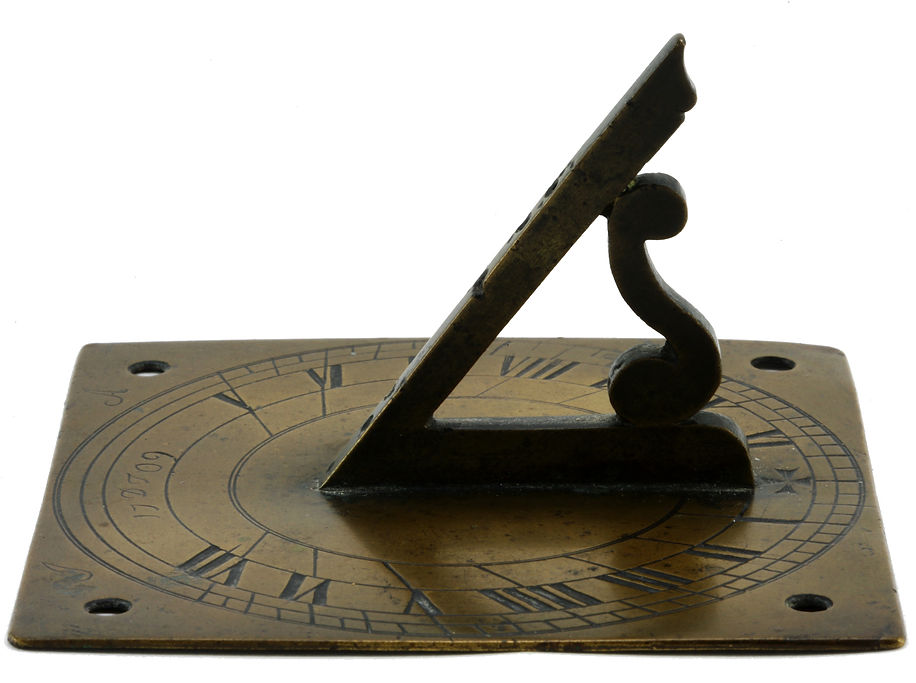
This very rare clockmakers sundial which has been signed by its maker is possibly the work of Deodatus Threlkeld , who was working in Newcastle during this time. The J. A. is probably the initials of the first owner and may well be for John Aynsley who was a close friend to Threlkeld for many years. Click here to see my full article which is shown alongside historic high quality paintings of the period. Private collection, Photographed by Lee Borrett.
