
Early Clocks | Lee Borrett
John Sanderson
Wigton, c1690s
of
An exceptionally rare early eight-day religious-versed longcase clock by John Sanderson of Wigton, dating from the early 1690s and believed to be his earliest surviving example.


An Important
Early Wigton Clock
Illustrated here is a remarkably rare seventeenth-century eight-day longcase clock by John Sanderson of Wigton, dating from the early 1690s.
At present, this appears to be the earliest known surviving eight-day clock by Sanderson, making it an especially important survivor in the history of early clockmaking in Wigton and the development of what has become known as the Wigton School of Clockmaking. The clock is particularly interesting not only because of its early date, but also because it retains a number of features that appear to belong to Sanderson’s earliest period of work. These include the distinctive meeting arrowhead and C-scroll half-hour markers, together with the inclusion of the word “Of” within his signature: 'John Sanderson of Wigton Fecit'. The combination of these features provides valuable evidence for understanding the development of Sanderson’s work during the early years of his career. The eleven-inch square brass dial is also notable for its deeply engraved religious verses, reflecting the devotional character found on a number of Sanderson’s earliest surviving clocks.
The Dial
The eleven-inch square solid-sheet brass dial is particularly attractive and unusually busy in its engraving. The chapter ring incorporates meeting arrowhead and C-scroll half-hour markers, features which appear to belong to Sanderson’s earliest work. The outer chapter ring numerals also display several charming early characteristics, including the distinctive curled tails to the numeral 5s, together with the letter “S” for strike. Sanderson has signed the chapter ring: 'John Sanderson of Wigton Fecit'. The inclusion of the word “Of” is particularly significant. On the earliest Sanderson clocks presently known to me, this form of signature occurs alongside the meeting arrowhead and C-scroll half-hour markers. These features appear to have been abandoned as Sanderson’s style developed during the later 1690s.
The dial centre is exceptionally busy, incorporating ringed winding holes, a ringed seconds circle, a circular date aperture and further engraved rings surrounding the central arbor. Most importantly, the dial carries several religious inscriptions. Below the seconds ring is the Latin inscription:
Memento Mori meaning “ Remember that you must die” The upper corners carry two further verses: “As time and clock and all things pass away”
and “A mend your lives for here wee must not stay.”
Together, these inscriptions transform the dial from a purely functional timekeeping instrument into a deeply personal reminder of the passing of time and the inevitability of death.

Above Wonderfully interesting eleven inch square brass dial of the early John Sanderson religious versed 8-day longcase clock. Dating from the early c1690s. Photograph by Lee Borrett
Below. Showing a close-up of the busy dial centre, with the engraved religious verse ' Memento Mori', seconds ring and round date calendar. Sanderson was also using the Westmoreland calendar wheel on his early 8-day examples. Photograph by Lee Borrett

The Religious Verses
The religious character of this clock is particularly appropriate when considered against the remarkable history of the Wigton district.
As discussed elsewhere in my article on the Wigton School of Clockmaking, John Sanderson’s early life was closely connected with Tiffinthwaite Farm and the Pearson family, who were prominent within the early Quaker community around Wigton. A number of Sanderson’s early clocks bear religious verses, often taking the form of Memento Mori inscriptions reminding the owner of the brevity of earthly life and the inevitability of death. It would be tempting to assume that these clocks were specifically made for Quaker customers, but there is presently no documentary evidence to prove this. The inscriptions should therefore be regarded as evidence of the strongly religious culture of the period rather than proof of a particular religious clientele. Nevertheless, the presence of these verses on Sanderson’s earliest clocks provides a fascinating insight into the world in which he worked.

Above The top left dial corner reads:- ' As time and cllock and all things pass away ' Photograph by Lee Borrett

Above. The top right hand dial corner reads:- ' A mend your lives for here wee must not stay ' Photograph by Lee Borrett
The Earliest
Sanderson Dial Features
The meeting arrowhead and C-scroll half-hour markers deserve particular attention. From my own study of early Sanderson clocks, I currently know of four examples, including a genuine lantern clock, which display this combination of features together with the inclusion of “Of” in Sanderson’s signature. These appear to belong to the earliest phase of his work, probably dating from the early 1690s. Interestingly, the same type of meeting arrowhead and C-scroll half-hour markers can also be found on early clocks by John Ogden, the Quaker clockmaker of Bow Bridge in Yorkshire, under whom Sanderson is traditionally thought to have trained.
Although there is no documentary evidence presently known to prove that Sanderson served his apprenticeship with Ogden, the similarities are intriguing. It seems entirely plausible that Sanderson’s earliest dials reflected the horological tradition in which he learned his craft before he developed the distinctive features that would later become characteristic of his own work. By approximately c1695, Sanderson appears to have moved away from these early half-hour markers, while the use of “Of” in his signature also seems to have disappeared by around c1698. For this reason, the combination found on this clock is particularly valuable in helping to place it within the earliest years of Sanderson’s career.

Above. Meeting arrow heads with 'C ' scrolls, for half-hour markers plus the inclusion of the word ' of ' in his signature, are all features of John Sanderson's earliest known work, which I believe date from the early 1690s. ' Photograph by Lee Borrett
Below. Showing the dial of another very early Sanderson clock. This time a 30-hour, but with the same type of meeting arrow heads with 'C ' scrolls, for half-hour markers plus the inclusion of the word ' of ' in his signature. Date early 1690s. Photograph courtesy of private Collector

Below. Showing a very rare true lantern clock by John Sanderson (later converted to fusee movement). Dating from the early 1690s is has again got the same type of meeting arrow heads with 'C ' scrolls, for half-hour markers plus the inclusion of the word ' of ' in his signature. Photograph courtesy of private Collector
.jpg)
The Eight-Day Movement
The substantial brass and iron eight-day movement is a particularly fine survival.
It retains its original wheelwork and brass collets and incorporates five-finned and ringed brass pillars, characteristic of Sanderson’s early work.
The movement also retains repeat work, an early form of rack striking, together with a strike-silent facility.
The pillars themselves are particularly interesting. On one of the lower pillars Sanderson has carefully shaved one end to provide sufficient clearance for the winding wheel. Such small details provide a fascinating glimpse into the practical working methods of the early clockmaker.
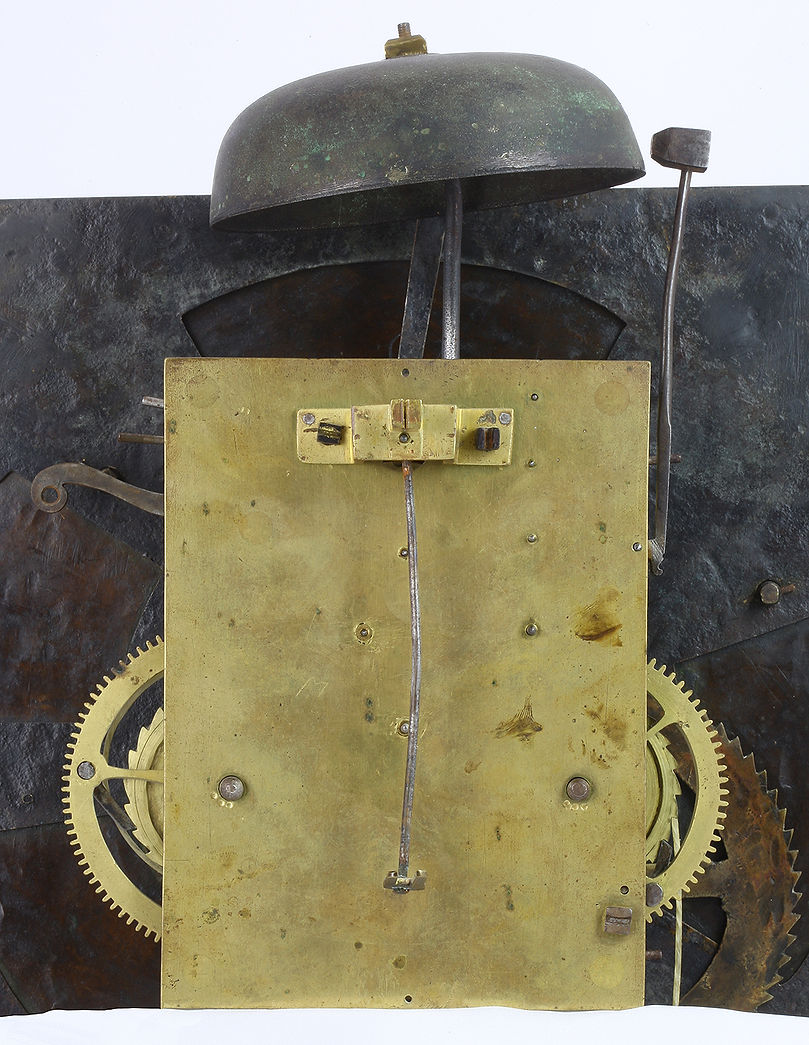
The movement also retains a fancifully shaped lever associated with the repeat work.
On the rear of the chapter ring are examples of Sanderson’s practice engraving, providing an unusually intimate glimpse of the maker at work.
These surviving traces of the maker’s hand are, to my mind, every bit as interesting as the more obvious decorative features of the clock.

Above. Showing the Five-finned and ringed pillar movement of the early John Sanderson 8-day longcase clock. It retains all of its original wheel work and collets has repeat works. It has an early form of rack striking and also has a strike silent feature. Photographed by Lee Borrett
Below. Showing a close-up of the finned and ringed brass pillars. Note that Sanderson has shaved the bottom pillar one end to give enough clearance for the winding wheel. Photographed by Lee Borrett

Below. Showing a rear view of the early John Sanderson 8-day movement. Note the fancily shaped lever for the repeat works. Photographed by Lee Borrett
Below. Showing a close-up of some practice engraving by John Sanderson on the back of his chapter ring. Photographed by Lee Borrett

A Rare Glimpse of the
Maker at Work
One of the most enjoyable aspects of studying an early clock such as this is discovering the small details that were never intended to be seen by the eventual owner.
The practice engraving found on the reverse of the chapter ring is a wonderful example.
Rather than being part of the finished decoration, these marks appear to represent Sanderson experimenting with his engraving technique.
For a collector, details such as this can bring us unusually close to the individual craftsman who made the clock more than three centuries ago.
The clock is housed in a remarkably substantial and highly attractive panelled oak case, which is itself a rare and important survival from the period. The case has a wonderfully primitive character. The trunk door is constructed from oak panels and is secured by two substantial blacksmith-made iron hinges. Below the trunk door are two further oak panels, with another panel forming the lower section of the case. Its heavy construction and panelled design suggest that it may have originally matched a much larger, panelled domestic interior. Further research into the history of the clock indicates that the case was almost certainly married to the Sanderson movement at some point in its earlier history and should therefore not be regarded as the original case made specifically for this clock. This does not, however, diminish the importance of either the clock or the case. The early Sanderson movement is an exceptionally rare survivor from the formative years of Wigton clockmaking, while the substantial seventeenth-century oak case is itself an important piece of early English craftsmanship.
Indeed, the combination is a fascinating example of the way in which early clocks and their cases could have acquired new histories through changing ownership and circumstances over the centuries. The case may not have been made for this particular Sanderson movement, but it now forms an important part of the clock’s surviving history. For the collector, I believe it is important to record this honestly. Rather than attempting to suggest that the case and movement are original to one another, I prefer to celebrate both for what they are: an exceptionally early and important Sanderson movement, together with a rare and characterful seventeenth-century oak case that has been brought together with it during the clock’s long history.
The Oak Case
Right. The trunk door is pannelled and is held in place by two primitive iron blacksmith hinges. There are two more oak panels below the trunk door and a further panel to the base. Originally the case may have been made to match a pannelled room. Photographed by Lee Borrett

John Sanderson and
The Wigton School
John Sanderson was born in 1671 and was brought up at Tiffinthwaite Farm near Wigton, where his father, Robert Sanderson, worked as a blacksmith. The family are believed to have lived in buildings associated with the farm. It has traditionally been suggested that Sanderson may have served his apprenticeship under the Quaker clockmaker John Ogden of Bow Bridge, Yorkshire, during the 1680s. However, no surviving apprenticeship documentation has yet been found to confirm this, and the suggestion must therefore remain tentative. By about 1691, Sanderson was back in the Wigton area and established as a clockmaker. He subsequently became the central figure in what has become known as the Wigton School of Clockmaking, a distinctive regional tradition whose principal early makers included Sanderson, John Ismay and Richard Sill.
This clock is particularly important because it belongs to the very earliest years of Sanderson’s career, when his distinctive style was still developing.
Why This Clock
Is Important
For me, the importance of this clock lies in the combination of several unusually early features.
It is:
-
an exceptionally early eight-day Sanderson;
-
apparently the earliest known surviving eight-day clock by the maker;
-
signed “John Sanderson of Wigton Fecit”;
-
fitted with the distinctive early meeting arrowhead and C-scroll half-hour markers;
-
decorated with deeply engraved religious verses and Memento Mori;
-
retaining its early five-finned and ringed pillars;
-
remarkably complete in its wheelwork and brass collets;
-
and housed in a highly unusual and substantial period panelled oak case.
Taken together, these features make this an exceptionally important survivor for the study of the early Wigton School.
Summary
This remarkable clock provides a rare opportunity to see the work of John Sanderson at the very beginning of his career. The early dial features, the use of “Of” within his signature, the religious inscriptions and the substantial eight-day movement all point towards an early date, probably within the first half of the 1690s. Its survival is particularly fortunate. Few provincial clocks of this period remain in such an interesting state, and fewer still can provide such clear evidence for the development of one of the earliest identifiable regional schools of English clockmaking outside London. The religious verses are also significant. They remind us that these clocks were made for people living in a deeply religious society, where the passing of time was not simply a matter of regulating the day but could also serve as a constant reminder of mortality. For me, however, it is the small details that make this clock especially fascinating: the early signature, the unusual half-hour markers, Sanderson’s practice engraving, the beautifully worked pillars and the surviving original movement components. More than three hundred years after it was made, these details allow us to see not merely the clock, but something of the craftsman behind it.
Acknowledgement
I would like to record my sincere gratitude to the late Brian Loomes, whose pioneering research did more than anyone else’s to establish our modern understanding of John Sanderson and the Wigton School of Clockmaking.
His book Brass Dial Clocks, with its important chapter on the Wigton School, together with his many published articles on Sanderson and the early Cumbrian makers, remains essential reading for anyone interested in this remarkable regional tradition.
I am also extremely grateful to Brian Wellings for his generous advice, encouragement and assistance during my own research into the Wigton School.
Much of the historical background presented in this article has been informed by Brian Loomes’s published research. I have also incorporated observations arising from my own study of surviving Sanderson clocks, together with additional information and newly discovered examples that have come to light since the publication of his original work.
As further clocks and documentary evidence continue to emerge, our understanding of John Sanderson and the early Wigton School will no doubt continue to develop. Brian Loomes’s pioneering scholarship remains the foundation upon which much of that continuing research is built.