
Early Clocks | Lee Borrett


John Sanderson
of
Wigton, c1700
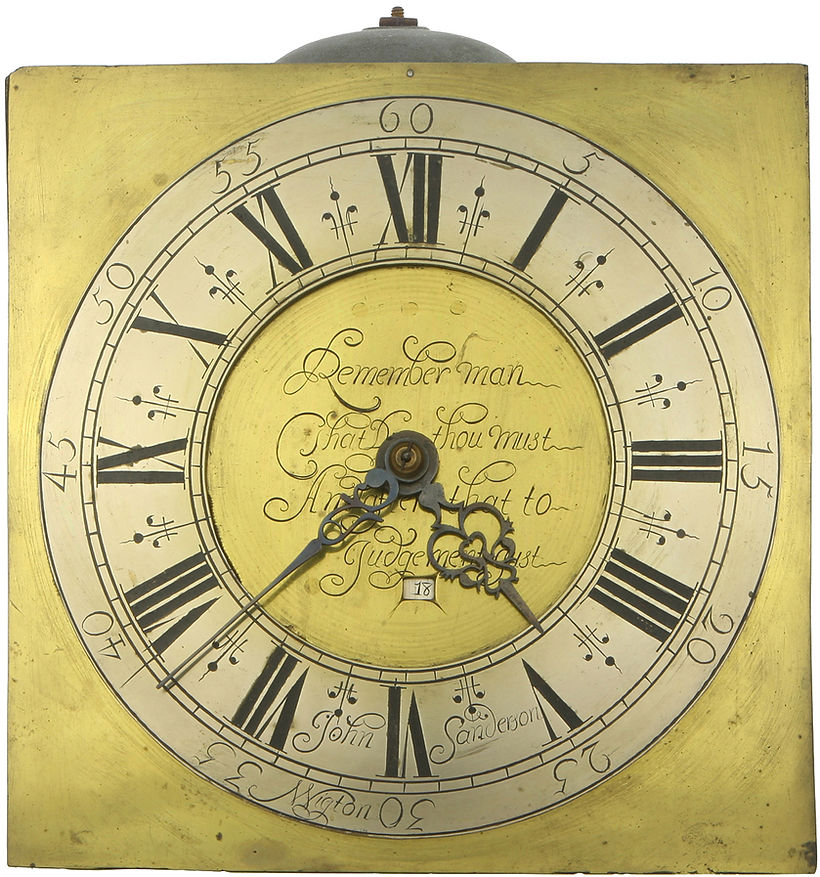
The wonderfully interesting religious thirty-hour clock illustrated here was made by John Sanderson of Wigton around c.1700. Its polished dial centre is deeply engraved with one of Sanderson’s characteristic devotional verses: ‘Remember man, That Die thou must, And after that, To judgement just’. The absence of spandrels and the substantial brass-and-iron lantern-style movement are both typical of his early work. Apart from one lantern foot having been replaced at some point in the clock’s long history, the movement survives in remarkably original condition, retaining its early wheelwork and brass collets. The clock is now housed in a wonderfully primitive early oak longcase with no true base. Particularly intriguing is a front panel bearing the initials of an early owner and the date 1703, apparently fixed around a small cross-like device. Whether this date records a marriage or another important family event cannot now be proved, but it gives the case a wonderfully personal and devotional character.
The Religious Versed
Dial Centre
Above. Showing the eleven inch square brass dial of the interesting John Sanderson religious 30-hour, c1700..Photographed by Lee Borrett
The deeply engraved verse occupying the polished centre of the dial is one of the most striking features of the clock:
‘Remember man,
That Die thou must,
And after that,
To judgement just.’
This is a powerful example of the Memento Mori tradition that appears on a number of Sanderson’s early clocks. Rather than treating the dial simply as a means of displaying the time, Sanderson used it as a place for moral reflection. The passing of the hours became a constant reminder of the brevity of earthly life and the judgement believed to follow death. The presence of such verses on several early Wigton clocks is particularly interesting when considered alongside the strong Quaker and non-conformist connections of the Wigton district during this period.
Whether these clocks were specifically commissioned for Quaker families cannot presently be established, but the repeated appearance of devotional inscriptions provides an important insight into the religious environment in which Sanderson was working.

Above. Showing a close-up of the John Sanderson signature with attatched trident half-hour markers.Photographed by Lee Borrett
Below. Showing a close-up of the polished dial centre which is deeply engraved with Sanderson's well known religious verse which reads: 'Remember man, That Die thou must, And after that, To judgement just'..Photographed by Lee Borrett

The Early Sanderson
Movement
The movement is a substantial and heavily built example of Sanderson’s early lantern-style construction, using brass and iron with turned brass pillars. Typically of Sanderson, the movement is attached to the dial by pinning at the top and lugging at the bottom, a constructional feature found on a number of his early clocks. Apart from the replacement of one lantern foot, the movement has survived in an exceptionally original state. Its original wheelwork and brass collets remain, providing an unusually valuable record of Sanderson’s early workmanship. The movement currently rests upon two oak blocks within the case, while the replaced lantern foot provides an intriguing clue to the clock’s earlier history.
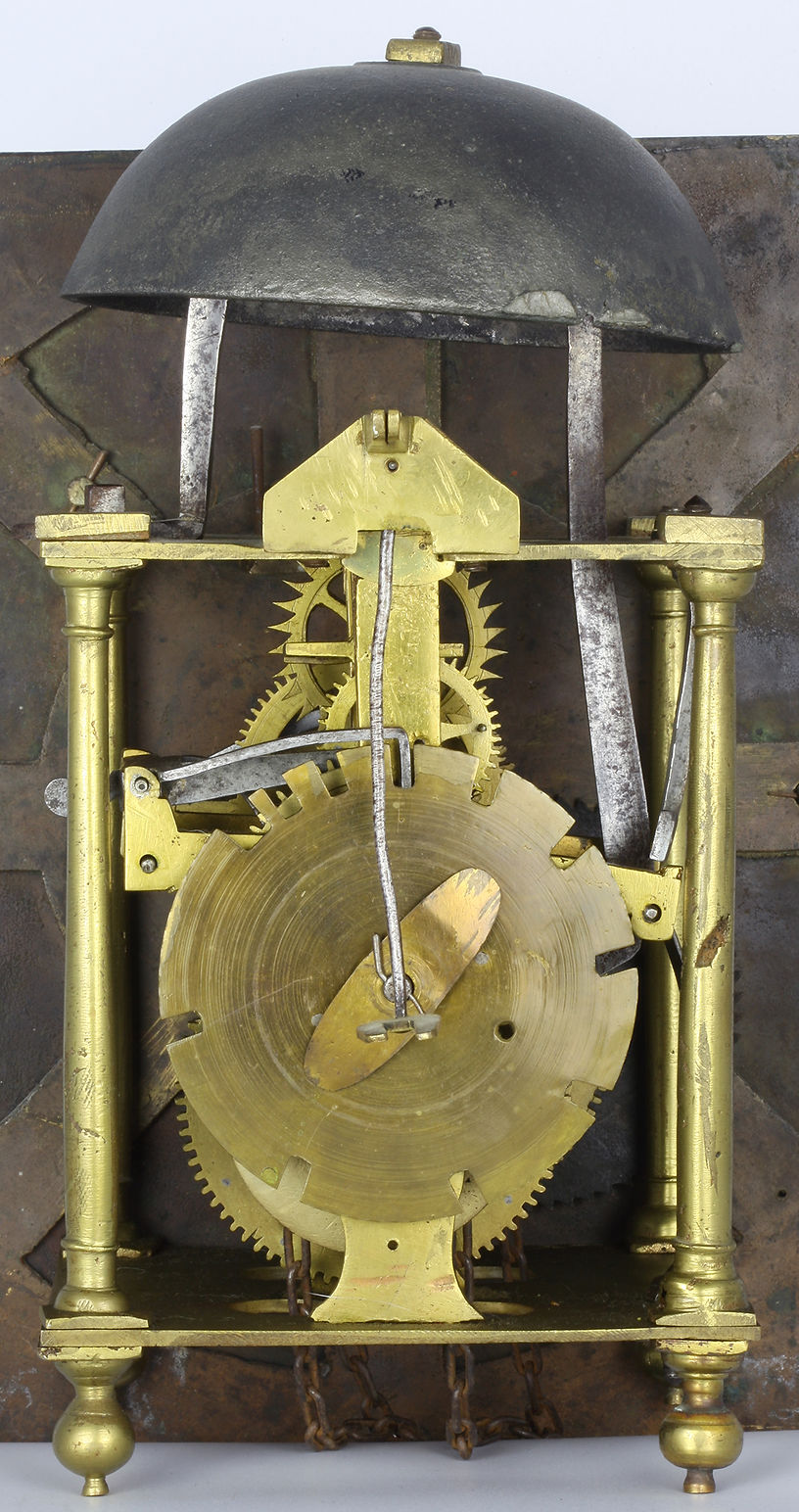
Above. Showing a rear view of the John Sanderson heavily built lantern type brass and iron movement which is typical of his early work. Photographed by Lee Borrett
Below. Showing a side view of the John Sanderson lantern type movement sitting on two oak blocks. Apart from one of the rear lantern feet having been replaced at some point in its past, the movement survives in remarkably original condition, retaining its early wheelwork and brass collets. Photographed by Lee Borrett

Below. Showing a view of the top plate. Typically, Sanderson has fixed the movement to the dial by pinning the top and lugging the bottom. Photographed by Lee Borrett

A Remarkable
Early Oak Case
The clock is housed in a wonderfully primitive and unusually interesting early oak longcase, standing approximately 90 inches high. The case has no true base and is constructed from substantial oak panels, with a 62-inch trunk measuring just over ten inches wide. The trunk door is fitted with a superb old glass lenticle extending across much of its width, the glass retaining the imperfections, bubbles and irregularities characteristic of early surviving examples. The case has hanging barley-twist pillars to both the hood and trunk, while the trunk door is fitted with a ‘D’ moulding and primitive construction throughout. Perhaps most fascinating of all is the evidence preserved within the hood that reveals something of the case’s own history.
Close examination reveals that the hood was originally constructed as a rising hood with no hood door opening rather than in the form in which it appears today. At some point during the case’s long history, the hood was converted to the more conventional slide-forward, arrangement and at the same time a section was cut into the front of the hood and subsequently fitted with external hinges to create a small opening door, allowing access to the dial without the necessity of raising the entire hood. The external brass hinges associated with this alteration are therefore particularly interesting. Their presence should not necessarily be regarded as evidence of poor restoration or later interference; rather, they appear to record a practical modification made during the working life of the clock. For me, this is one of the most appealing aspects of the case. It records not only how the clock was originally constructed, but also how a previous owner adapted it to make the clock more convenient to live with and use. Like the replacement lantern foot on the movement, the altered hood is therefore part of the clock’s natural history.
Perhaps the most remarkable feature of the case is the small panel carrying the initials of the first owners together with the date 1703. The initials and date appear to have been separately attached or pinned to the panel, together with what appears to be a Christian cross. The date may represent a marriage date, although this cannot be established with certainty. If this interpretation is correct, the inscription could represent the moment when the clock became associated with a particular family. The combination of the religious verse on the dial and the religious symbol accompanying the initials and date on the case is particularly evocative.
It raises the intriguing possibility that the clock and case eventually became associated with a deeply religious household in the Wigton district, although it would be unwise to claim more than the surviving evidence allows us to establish.


The wonderfully primitive early oak case with hanging barley-twist pillars, glass lenticle and external hinges. Close examination suggests that the hood was originally of the rising type and was later altered to provide frontal access. The case stands approximately 90 inches high Photographed by Lee Borrett

Above. The front panel bearing the initials of an early owner and the date 1703, apparently arranged around a small cross-like motif. The date may commemorate a marriage or another important family event, although its precise meaning remains unknownPhotographed by Lee Borrett

Above. Medieval Christian Cross, Eleventh Century A.D. The Memento Mori concept has its roots in the philosophers of classical antiquity and Christianity, and appeared in funerary art and architecture from the medieval period onwards. Photographed by Lee Borrett
Below. Showing a close-up of the hanging barley-twist pillars together with the external brass hinges to the hood door. Photograph by Lee Borrett

Below. Showing a close-up of the superb trunk door glass lenticle with imperfections, flaws and bubbles. Photograph by Lee Borrett

Below. Showing a close-up of the trunk door brass latch. Photograph by Lee Borrett

It is thought that Sanderson sold many of his early thirty-hour clocks with their attractive brass lantern-style pillars at the local marketplace in Wigton and surrounding areas, potentially allowing purchasers to use them as wall clocks while keeping the initial cost relatively low. The lantern-style movement would have been attractive when displayed openly, rather than concealed within a wooden case. A purchaser could subsequently have commissioned or acquired a longcase when circumstances allowed, meaning that some of these early movements may have been cased at a later date.
From my own experience of studying and collecting early Wigton clocks, I believe that many of these religious-versed thirty-hour examples may initially have been used in this way and only cased later, either when the owner could afford to commission a case or when the clock eventually passed to another household. Some surviving examples have clearly been fitted into later cases, while others remain uncased today. I regard these changes not as defects but as part of the natural history of clocks that have survived for more than three centuries.
The present example may fit that pattern particularly well. One of its lantern feet has been replaced at some point in the past, which raises the possibility that the movement may once have suffered a fall while being used on a wall bracket or shelf. This cannot be proved, however, and neither can the date at which the movement entered the present oak case. What can be said is that both clock and case possess great historical interest in their own right, and their long association now forms part of the object’s surviving story.
Originally
A Wall Clock?

Above. 17th century hand coloured engraving of Westmoreland and Cumberland showing Wigton, by Robert Morden, published by Abel Swale Awnsham and John Churchil, London, about 1695. Lakes Guides website. Map "courtesy of Dove Cottage"
John Sanderson
of Wigton
John Sanderson was born in 1671 and spent much of his childhood at Tiffinthwaite Farm near Wigton, where his father Robert worked as a blacksmith. Sanderson later became the central figure in what is now known as the Wigton School of Clockmaking. It has long been suggested that he may have trained under the Quaker clockmaker John Ogden of Bowbridge in Yorkshire, although no apprenticeship indenture has yet been found to prove this. The similarities between Sanderson’s earliest surviving clocks and Ogden’s work nevertheless suggest a close connection or shared workshop tradition. By the early 1690s Sanderson was working as a clockmaker in the Wigton district and was producing the distinctive religious-versed clocks for which he is now best known.
Summary
This remarkable clock is much more than an early thirty-hour Sanderson.
It is a fascinating survival in which clock, case, faith and family history have become intertwined over more than three centuries.
The early religious verse on the dial provides a direct insight into the deeply devotional character of some of Sanderson’s work, while the unusual oak case preserves evidence of its own changing history — from its original rising hood to the later alterations made for everyday use.
Most intriguing of all is the 1703 inscription, with its initials, date and apparent Christian cross. Whether this represents a marriage or another significant event in the lives of the original owners remains unknown, but it gives the clock a very personal dimension.
For me, the replaced lantern foot, the altered hood, the imperfect early glass lenticle and the primitive construction of the case are not imperfections to be hidden. They are all part of the clock’s story.
After more than three hundred years, this is precisely the sort of early Wigton clock that can still tell us something about the people who made it, the people who owned it and the religious world in which it first appeared.
And perhaps that is what makes these early clocks so special. They do not simply measure the passage of time — they preserve it.
Acknowledgement
I would like to express my sincere gratitude to the late Brian Loomes, whose pioneering research did more than that of anyone else to advance our understanding of John Sanderson and the Wigton School of Clockmaking. His book Brass Dial Clocks, which contains an important chapter on the Wigton School, together with his article on the subject published in Clocks Magazine in April 2006, remain essential sources for anyone interested in these remarkable Cumbrian clockmakers.
Much of the historical and horological background presented in this article has been informed by Brian Loomes’s published research. I have also incorporated additional information arising from my own study of surviving clocks, including examples that have come to light since his original research was published, together with my own observations and opinions where these are clearly identified as such.
Brian’s work has provided an invaluable foundation for collectors and researchers, and I hope that the additional observations presented here will contribute, in a small way, to the continuing study and appreciation of John Sanderson and the remarkable clocks of the Wigton School.
