
Early Clocks | Lee Borrett
An early
John Sanderson
Memento Mori, Wall Clock
The religious character of this remarkable clock is immediately apparent. Unlike most early Sanderson dials, where a single devotional inscription might accompany the timekeeping functions, almost the entire nine-inch dial is given over to religious admonition. The combination of multiple verses, the unusually small dial and the clock’s probable original use as a wall clock makes this an especially rare survivor.

A remarkable
religious-versed 30-hour
Clock with an unusually
small nine-inch dial
Illustrated here is a remarkably rare early eighteenth-century 30-hour wall clock by John Sanderson of Wigton, made circa 1710–1715. At first glance, it may appear to be a relatively simple example of Sanderson’s early work. Closer examination, however, reveals an extraordinary feature: almost the entire surface of its small nine-inch square brass dial is covered with deeply engraved religious verses. The clock is therefore much more than a timekeeper. Its dial appears to have been conceived as a continuous reminder of the brevity of human life, the inevitability of death and the need for repentance. For me, this makes it one of the most fascinating surviving examples of Sanderson’s early religious-versed clocks.
An Unusually
Small Sanderson Dial
One of the first things that distinguishes this clock is its diminutive size.
The solid-sheet brass dial measures only approximately nine inches square, considerably smaller than the 11- and 12-inch cartwheel-type dials that Sanderson was increasingly using by the later part of his career. The dial is fitted with a square-box calendar aperture and an applied chapter ring with floating fleur-de-lis half-hour markers. Across the dial is the signature: John
Sanderson Wigton Fecit. The relatively small dial, combined with the 30-hour movement and lantern-style construction, gives the clock a particularly intimate character. It is also the religious engraving, however, that makes this survivor truly exceptional.
with Religious Warnings
A Dial Covered
Unlike many Sanderson clocks, where a single religious verse may occupy the dial centre or upper corners, this example carries multiple separate religious inscriptions, carefully distributed across almost the entire dial.
The principal verse across the upper part of the dial reads: “Our days and years here will quickly spend, Eternity will come that has no end.” At the centre is another deeply personal warning: “As time and clock and all things pass away, Amend your lives for here we must not stay.” In the lower left-hand corner is the Latin: “Esto Memor Mortis”— Remember death. The lower right-hand corner carries the inscription: “Libile Tempus a bit” which appears to be intended as a Latinised warning concerning the passing of time.
Taken together, the inscriptions create an unusually powerful message.
The clock is not merely telling its owner what time it is. The dial is continually reminding the owner that time is passing, that earthly life is temporary and that eternity lies beyond it.

Above. Showing the wonderfully interesting nine-inch square brass dial wall clock signed John Sanderson Wigton Fecit, c1710. Photograph by Lee Borrett

Above The verse to the dial centre reads ‘As time and clock and all things pass a way, A mend your lives for here wee must not stay’ Photograph by Lee Borrett

Above and Below images read:- The verses from left to right and across the top of dial read: - ‘ Our days and years here will Quickly spend, Eternity will come that has no end. Photograph by Lee Borrett

Below image reads:- To the bottom left hand corner the verse reads " Esto Memor Mortis" Photograph by Lee Borrett

Below image reads:- to the bottom right hand corner it reads 'Libile Tempus a bit' Photograph by Lee Borrett

Below. Signed John Sanderson Wigton, Fecit . Photograph by Lee Borrett

Memento Mori
The religious character of the clock belongs to the much older Christian tradition of memento mori—the Latin expression meaning “remember that you must die.” During the seventeenth and early eighteenth centuries, reminders of mortality were widespread throughout European Christian culture. Vanitas paintings, funerary art, religious inscriptions and personal objects frequently incorporated imagery and words intended to remind the viewer of the temporary nature of earthly life. For a clockmaker, the symbolism was particularly appropriate. Every movement of the hands provided another reminder that time was passing. On this particular clock, Sanderson appears to have taken that idea considerably further than usual. Rather than placing a single moral inscription upon the dial, he covered much of the available surface with verses carrying essentially the same underlying message.
A Clock for a Particularly
Devout Owner?
This raises perhaps the most intriguing question surrounding the clock.
Why did Sanderson engrave so many religious verses upon this particular dial? It is possible that the answer lies with its original owner. The surviving evidence cannot tell us who commissioned the clock, nor can we prove that it was made specifically for a Quaker or other non-conformist family. Nevertheless, the unusual concentration of religious inscriptions makes it tempting to consider whether this was a specially commissioned clock for an exceptionally devout individual or household. This is, however, my own interpretation rather than an established fact. The connection is nevertheless particularly interesting because of Sanderson’s own association with the Quaker community around Wigton. As discussed in my article on the Wigton School of Clockmaking, Sanderson’s childhood was closely connected with Tiffinthwaite Farm and the Pearson family, an important centre of early Quakerism in Cumberland. Whether the religious character of clocks such as this one was directly connected with Quaker patrons remains impossible to prove. What can be said with certainty is that religious verses form an important and recurring feature of Sanderson’s earliest surviving work.

A Movement
Intended to be Seen?
Above. Showing a rear view of the John Sanderson 30-hour wall clock. highly interesting religious wall clock with lantern type turned pillars. Note Sanderson's typical pyramid-shaped back cock. Photograph by Lee Borrett
The movement provides another important clue to the clock’s original form.
This is a substantial 30-hour Sanderson movement with lantern-style turned brass pillars. Several features are characteristic of Sanderson’s early work, including the large and distinctive pyramid-shaped back cock and his unusual method of attaching the dial to the movement. The dial is secured by two upper pins positioned towards the centre of the top plate, together with a lower central lug attached to the bottom plate. Most remarkably, the movement has survived in an exceptionally original and complete condition. The wheelwork and brass collets remain intact, providing an unusually valuable opportunity to study Sanderson’s early construction.

Above. The movement has survived in a very original and complete condition throughout including its wheel-work and brass collets. The dial is secured by two upper pins positioned towards the centre of the top plate, together with a lower central lug attached to the bottom plate. Photograph by Lee Borrett
Below. Showing a close-up of the top-plate. Photograph by Lee Borrett

A Wall Clock?
Originally
The clock’s present arrangement provides an interesting clue to its original purpose. It has survived without a longcase and is currently mounted upon a later oak backboard using a pair of later, individually made antique iron brackets. These fittings are clearly not original to the clock. Rather than detracting from the clock, however, this later mounting arrangement may actually help illustrate its natural history. As discussed in my Wigton School article, I believe that many of Sanderson’s early 30-hour lantern-style clocks may originally have been sold as relatively inexpensive wall clocks, allowing their owners to display the decorative brass movement without the considerable expense of commissioning a wooden longcase.
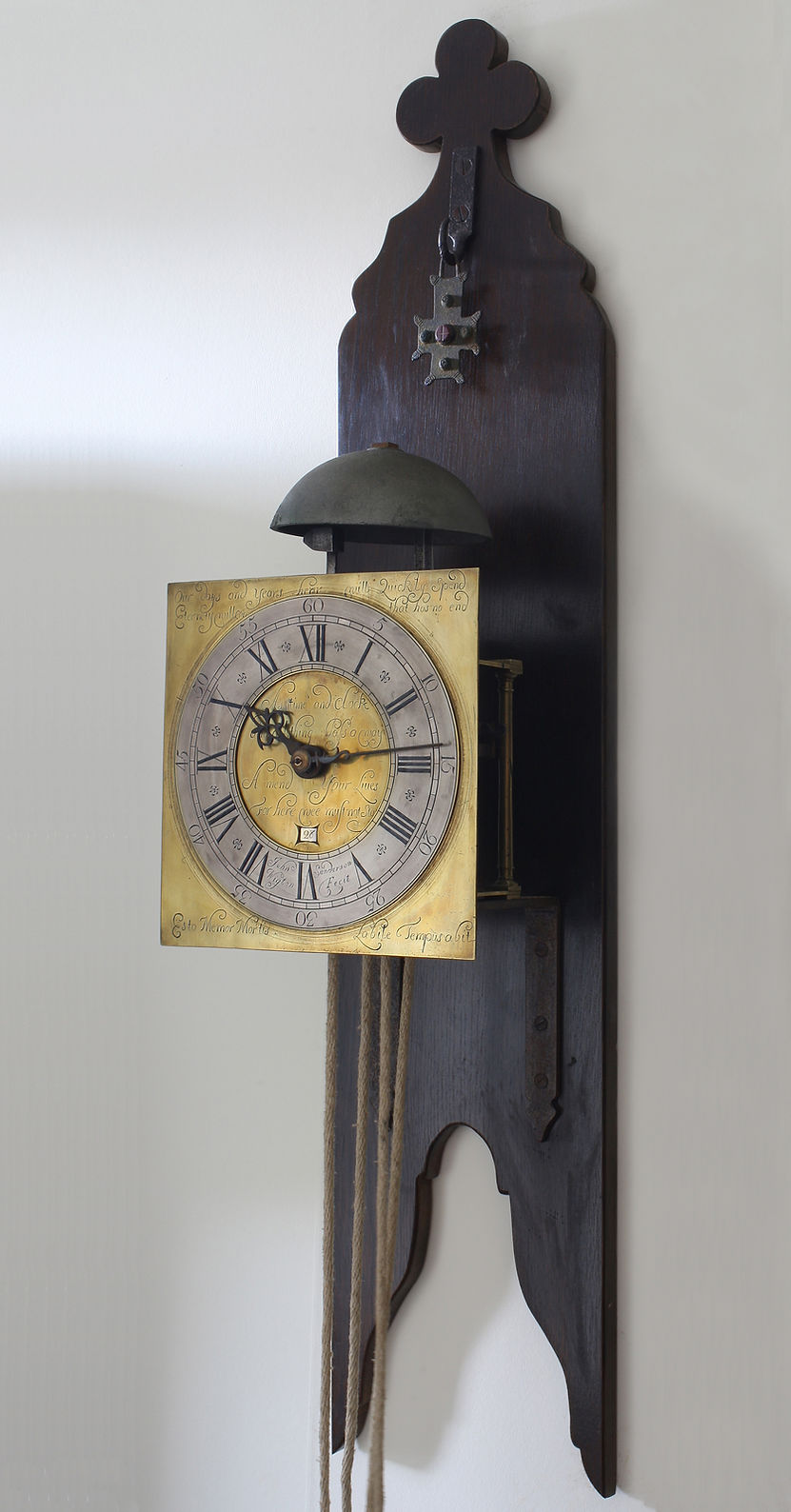
Above and Below images. Showing the John Sanderson 30-hour religious versed wall clock sitting on it's later antique iron brackets with oak backboard. The hanging Medieval Christian bronze cross, dates between c.1100 –1200 AD. Photograph by Lee Borrett

A Clock Made for the Market
for One Particular Family?
or
Sanderson’s early 30-hour clocks may have been sold through the local markets around Wigton and the surrounding districts, providing an affordable means of acquiring a domestic clock. The decorative brass pillars would have been fully visible when the movement was mounted on a simple wall bracket, while the absence of an expensive wooden case would have kept the initial cost considerably lower. This particular clock, however, makes me wonder whether it may represent something slightly different. The unusually small nine-inch dial, combined with the extraordinary quantity of religious engraving, gives the impression of something more personal than a standard market clock. By the later years of Sanderson’s career, larger 11- and 12-inch cartwheel-type dials had become increasingly characteristic of his work. To find a clock dating from around 1710–1715 with such a small solid brass dial, and with almost every available area covered with religious inscriptions, is highly unusual. For me, these features raise the possibility that this was a specially commissioned clock, perhaps made for a particular individual or family whose religious convictions were especially strong. There is no documentary evidence presently known to prove this, but the surviving clock certainly invites the question.
An Exceptionally
Original Survivor
Perhaps one of the most appealing aspects of this clock is its condition.
Although the present iron brackets and oak backboard are later additions, the clock itself has survived in a remarkably original state. The movement retains its original wheelwork, brass collets and characteristic early construction, while the dial preserves its unusual engraving almost completely intact. For a collector of early provincial clocks, this is particularly important. The clock has not been heavily modernised or transformed into a conventional longcase clock. Instead, it allows us to see something much closer to the type of 30-hour Sanderson movement that may originally have been installed upon a wall. In that respect, the later brackets are almost incidental. The clock itself remains the important survivor.
John Sanderson of Wigton
John Sanderson was born in 1671 and was brought up at Tiffinthwaite Farm near Wigton, where his father Robert was the blacksmith. The family are believed to have lived in buildings associated with the farm. Following his father’s death when John was approximately twelve or thirteen years old, he left Tiffinthwaite and went to live with his uncle John Sanderson and aunt Mabel at Highmoor. It has been suggested that Sanderson may subsequently have trained under the Quaker clockmaker John Ogden of Bow Bridge, Yorkshire, although no surviving apprenticeship indenture has yet been discovered to prove this. Comparisons between the earliest work of the two makers nevertheless reveal interesting similarities. Sanderson was back in the Wigton area by around 1690 and in 1691 married Elizabeth Pearson, granddaughter of William Pearson of Tiffinthwaite Farm. This brought him directly into one of the district’s important Quaker families and eventually placed him back at the farm where he had spent his childhood. It was within this remarkable social and religious environment that Sanderson developed the distinctive style of clockmaking for which he is now remembered.
Summary
This small 30-hour clock is, in my opinion, an exceptionally rare and important survivor of John Sanderson’s early work. Its diminutive nine-inch dial, lantern-style movement and, above all, its extraordinary collection of religious verses make it very different from the majority of Sanderson clocks that have survived. The words engraved across its dial repeatedly remind the owner that time passes, earthly life is temporary and eternity has no end.
Whether these inscriptions were intended specifically for a Quaker household, or whether they simply reflected the deeply religious character of their time, we may never know. For me, however, the combination of the unusually small dial, the remarkable quantity of religious engraving and the survival of the movement in such an original condition raises the intriguing possibility that this was not simply another clock produced for the local market, but a purpose-made clock for a particularly devout owner.
That remains a theory, rather than a proven fact. What is certain is that more than three centuries later, this little clock still performs the very task its maker intended. It tells us the time.
But its dial tells us something much more profound:
time passes, life is short, and eternity has no end!
Acknowledgement
I would like to express my sincere gratitude to the late Brian Loomes, whose pioneering research did more than that of anyone else to advance our understanding of John Sanderson and the Wigton School of Clockmaking. His book Brass Dial Clocks, which contains an important chapter on the Wigton School, together with his article on the subject published in Clocks Magazine in April 2006, remain essential sources for anyone interested in these remarkable Cumbrian clockmakers.
Much of the historical and horological background presented in this article has been informed by Brian Loomes’s published research. I have also incorporated additional information arising from my own study of surviving clocks, including examples that have come to light since his original research was published, together with my own observations and opinions where these are clearly identified as such.
Brian’s work has provided an invaluable foundation for collectors and researchers, and I hope that the additional observations presented here will contribute, in a small way, to the continuing study and appreciation of John Sanderson and the remarkable clocks of the Wigton School.
