
Early Clocks | Lee Borrett

Wonderfully historical lantern clock with original verge escapement. Made for the Yarpole Wedding of Edward Pardoe and Millborough Brown, at Yarpole Church in Herefordshire, 30th April,1692.
1692
Richard Savage
Richard Savage
ffecitt, 1692
The wonderfully interesting and historic lantern clock illustrated here was made by Richard Savage of Much Wenlock in Shropshire for the Yarpole Wedding of Edward Pardoe and Millborough Brown, at Yarpole Church in Hererordshire, 30th April, 1692.

Yarpole Church, Herefordshire. The clock was made for the wedding of Edward Pardoe & Milborough Brown of Yarpole. They were married on April 30th, 1692, by license in Yarpole Church.
Richard Savage was born at Much Wenlock, Shropshire, on 2 August 1663, the son of William and Joan Savage. He married Elizabeth Price of Bridgnorth in 1685/86 and was working at Much Wenlock during the period in which this clock was made. Their children included William, born on 15 September 1687, and Thomas, born on 17 August 1690. Savage later moved to Shrewsbury, probably during the later 1690s, where his sons entered the family trade. William was apprenticed to him in 1700 and Thomas followed a few years later. Elizabeth died in March 1722, and Richard subsequently married Margaret Jones in October 1726. He died in Shrewsbury in 1728. Savage became one of the most important early domestic clockmakers associated with Shropshire, and a number of his surviving lantern clocks are unusually dated and inscribed for their original owners.

Above. A fine seventeenth-century historic lantern clock made in 1692 by Richard Savage of Much Wenlock. The clock retains its original verge escapement and is of lovely proportions, standing approximately 15 inches high. Private collection, Photographed by Lee Borrett.

Above. Showing the beautifully engraved dial centre. Signed Richard Savage FFecitt (Made It) Original iron hand. Richard Savage is the first true clockmaker to be listed in the records of the Smiths' Company of Shrewsbury. Private collection, Photographed by Lee Borrett.

Above. Showing a side view of the Richard Savage 1692 movement. Nicely shaped hammer stop. Original verge escapement and bob pendulum. Private collection, Photographed by Lee Borrett.

Above. Showing the opposite side view. Note the original iron and brass gobet shaped collets. Original wheel-work, pinions and chain pulley's. Private collection, Photographed by Lee Borrett.

Above. Showing s close-up of Savage's original iron goblet shaped collect which is integral and direct to the wheel. Private collection, Photographed by Lee Borrett.

Above. Showing a close-up of Richard Savage's brass goblet shaped collet. Private collection, Photographed by Lee Borrett.

Above. Top plate. The clock retains it's original verge escapment. Note this clock has iron top and bottom plates which is a typical feature found on early Richard Savage clocks. Private collection, Photographed by Lee Borrett.
Below. The Fret. This clock was given as a wedding gift to Edward Pardoe & Milborough Brown of Yarpole. They were married on April 30th, 1692, by license in Yarpole Church. Private collection, Photographed by Lee Borrett.

Yarpole Church
Herefordshire

Above. Showing another view of Yarpole Church in Hererordshire where Edward and Millborough Brown were married on the 30th April, 1692. www.british-history.ac.uk
Wonderfully
Historical
Richard Savage Lantern Clock
Made for ye Yarpole Wedding of
Edward Pardoe and Millborough
Brown, at ye Yarpole church in
Herefordshire, 30th April,
Anno Domini
1692
This wonderfully historic lantern clock was almost certainly made to commemorate the marriage of Edward Pardoe and Millborough Brown at Yarpole on 30 April 1692. It may well have been commissioned as a wedding present, and Millborough’s father, John Browne, is a particularly plausible candidate. The surviving parish register, marriage licence and Edward Pardoe’s will provide an unusually rich documentary background to the clock, while the marriage licence preserves the signatures of Edward Pardoe and John Browne.
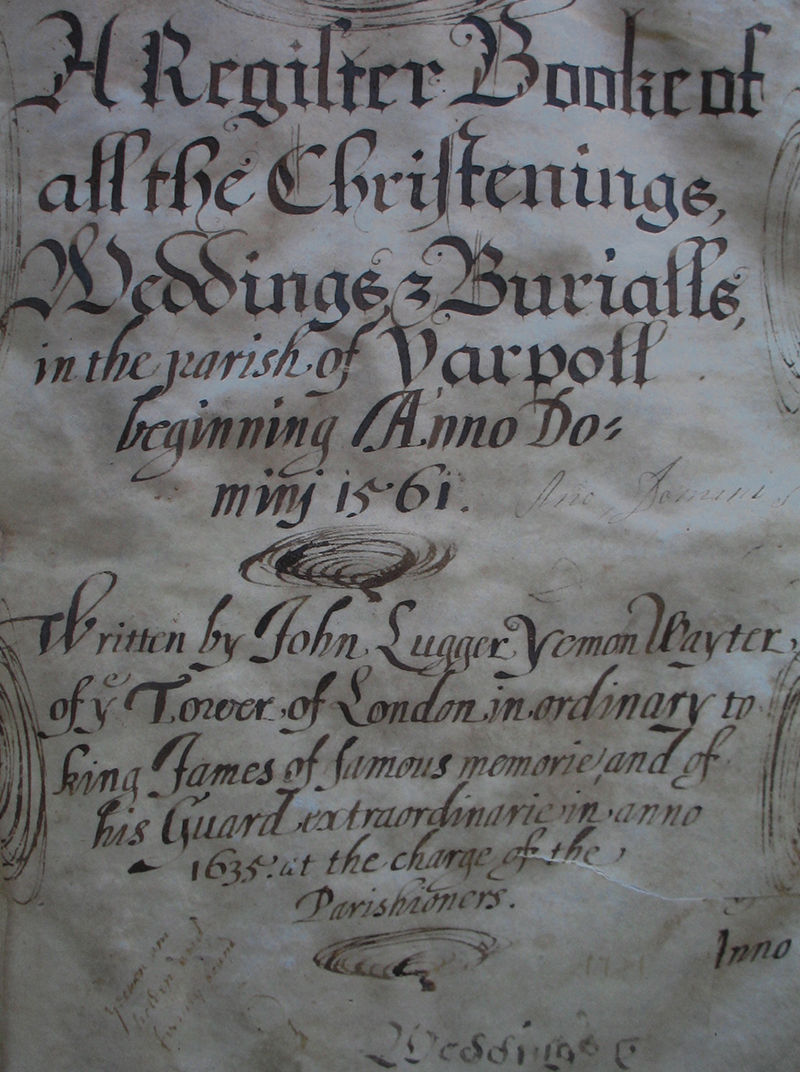
Above. Showing a front cover copy of the original Yarpole Register Book of the Christenings, Weddings and Burials.Herefordshire County Record Office.

Above. Marriage Register. Edward Pardoe of ye parish of Milford Globe in ye County of Salop & Milborough Brown of this parish were marryed April 30th by license. Herefordshire County Record Office.

Above. Marriage License. Showing the signatures of Edward Pardoe and John Browne (Millborough's Father). Herefordshire County Record Office.
Millborough was baptised at Yarpole in September 1667, the daughter of John and Ann Browne. She appears also to have had a sister, Ann, baptised in 1658. The personalised inscription upon the clock is exceptionally unusual for a lantern clock of this period and strongly suggests that it was specially commissioned for the marriage.
John Browne’s presence on the marriage licence makes him a particularly interesting figure. A John Brown is also mentioned in a Yarpole memorandum of 1672 concerning enclosed church pews and is styled “gent.” If this was Millborough’s father, it would suggest a man of some local standing and sufficient means to commission an expensive clock. It is therefore tempting to imagine him travelling to Much Wenlock to discuss the proposed wedding clock with Richard Savage. This remains an interpretation rather than documented fact, but the possibility fits the surviving evidence remarkably well.
St. Mary's Church
Bitterley
Edward & Milborough lived in Bitterley, Shropshire, where they had two children, Anna, born March 1695 and John born September 14th 1696 who were both baptised at St. Mary's Church in Bitterley. Yarpole village is only about 8 miles to the south west of Bitterley and is almost visible in the distance which must have been pleasing for Milborough to live within about only two hours or less travel from her parents by horse and carriage.

Above. The Church of St Mary is located in Bitterley, Shropshire. Photograph by Terry Rowntree.
The Church of St Mary was built in the 12th century and later, it is a Grade II listed building. Apon entering the church, there is a prominent and fabulous Pardoe family plaque on the south wall.

Above. Showing the inside of St Mary Church is located in Bitterley, Shropshire. Photograph by Terry Rowntree.

Above. Showing a close-up fabulous Pardoe family plaque on the south wall. Photograph by Terry Rowntree.
Unfortunately Milborough died only four years after her marriage to Edward and was buried at Bitterley in September 1696. Edward married again in 1699 and died in 1715, being buried back at Bitterley alongside his first wife, Milborough. The locatable graves of the Pardoe family lie together under the tower on the north west corner of the church yard.They are all very weatherworn and practically impossible to read.

Above. The locatable graves of the Pardoe family lie together under the tower on the north west corner of the church yard.They are all very weatherworn and practically impossible to read. Photograph by Terry Rowntree.
Summary
In summary, this is an exceptionally rare and wonderfully historic seventeenth-century lantern clock. It survives in remarkably original condition, retaining its original verge escapement, bob pendulum, wheelwork, pinions, collets and iron hand, while its dated wedding inscription gives it an unusually precise human history.
Made in 1692 by Richard Savage of Much Wenlock, the clock can be linked directly to the marriage of Edward Pardoe and Millborough Brown at Yarpole Church on 30 April of that year. The survival of the parish register and marriage licence allows the names engraved upon the clock to be connected with real people, a real place and an exact day more than three centuries ago.
Few lantern clocks of this period retain such complete documentary provenance. For me, that combination of originality, personal history and precisely dated manufacture makes this one of the most evocative surviving clocks of its type.
Acknoweledgements
I would like to thank the following for providing me with images and for allowing me to use any previously published material for this article.
My thanks go out to Terence Rowntree and his wife who helped me with this Richard Savage wedding clock article. Including cycling to Yarpole and Bitterley, spending many hours of their free time, gathering very historic information and supplying me with wonderful photographs and some of which are shown above.
I would also like to acknowledge with gratitude the late Brian Loomes, whose published research into Richard Savage and the early clockmakers of Shropshire provided important historical background for this article
Historically Important Events
Salem Witch Trials
of 1692
Edward and Millborough’s wedding day would have been a joyful occasion, celebrated with family and friends at Yarpole on 30 April 1692. Yet far across the Atlantic, on that very same day, the Salem witch crisis was continuing to intensify. On 30 April 1692 several girls accused the former Salem Village minister George Burroughs of witchcraft; he was arrested a few days later and ultimately executed in August. Thus, while one family in rural Herefordshire was celebrating a marriage, another extraordinary and tragic episode of seventeenth-century history was unfolding in colonial Massachusetts.
The Salem witch trials were a series of hearings and prosecutions of people accused of witchcraft in colonial Massachusetts between February 1692 and May 1693. More than 200 people were accused. Thirty people were found guilty, 19 of whom were executed by hanging (14 women and five men). One other man, Giles Corey, was pressed to death after refusing to enter a plea, and at least five people died in jail.

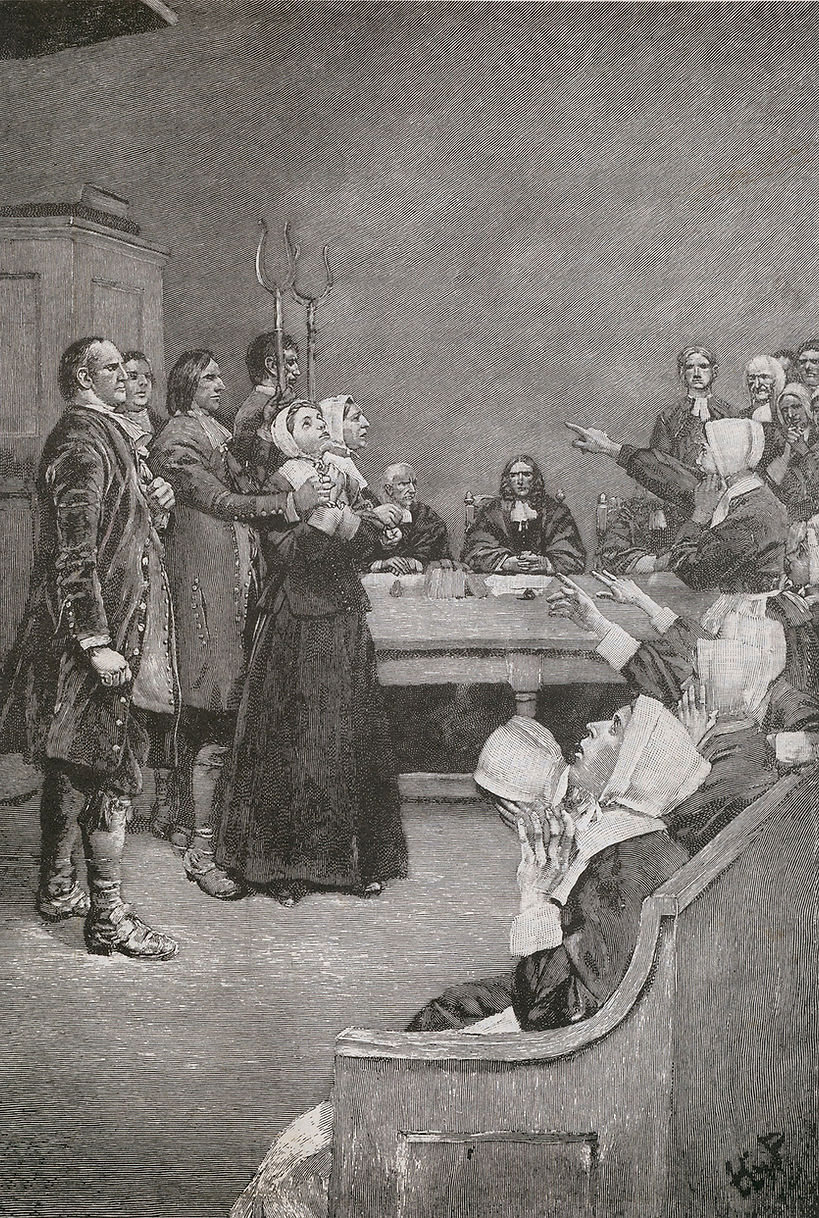
Above. Salem Witch Trials 1692. A women believed to be Mary Walcott protests as one of her accusers, a young girl, appears to have convulsions. A small group of women were the source of accusations, testimony, and dramatic demonstrations. Image. Shutterstock.com
Below. Salem Witch Trials 1692. Two women stand on trial in 1682 with guards, as the accusing girls demonstrate their demonic afflictions. Illustration by Howard Pyle. Image. Shutterstock.com
Arrests were made in numerous towns beyond Salem and Salem Village (known today as Danvers), notably Andover and Topsfield. The grand juries and trials for this capital crime were conducted by a Court of Oyer and Terminer in 1692 and by a Superior Court of Judicature in 1693, both held in Salem Town, where the hangings also took place. It was the deadliest witch hunt in the history of colonial North America. Only fourteen other women and two men had been executed in Massachusetts and Connecticut during the 17th century.

Above. Salem Witch Trials. Puritan Rev. George Burroughs in chains during his trial for witchcraft. Cotton Mather attended his execution by hanging on August 19, 1692. Image. Shutterstock.com
Below. Salem Witch Trial. Martha Cory in jail for witchcraft with her prosecutors. She was convicted by 'spectral evidence' provided by the young Ann Putman. She was executed by hanging on Sept. 22, 1692. Image. Shutterstock.com
.jpg)
Brief Summary
The Salem witch trials became one of the most notorious episodes in colonial American history. More than 200 people were accused of witchcraft. Nineteen were executed by hanging, while Giles Corey was pressed to death after refusing to enter a plea; others died in prison. The first hanging took place in June 1692, and the final executions occurred on 22 September of that year.
In later generations the trials came to be remembered as a powerful warning against fear, false accusation, intolerance and failures of justice. The process of clearing the names of those convicted continued for centuries, with Elizabeth Johnson Jr.—the last convicted person whose name had not formally been cleared—finally exonerated in 2022.
For the purposes of this clock, however, the most extraordinary coincidence remains the date itself. On 30 April 1692, Edward and Millborough were married at Yarpole while, on that very same day in Massachusetts, accusations were being made against George Burroughs as the Salem crisis gathered momentum.
Two completely different human stories, separated by the Atlantic Ocean, became linked forever by a single date: 30 April 1692.
Acknoweledgements
Historical information concerning the Salem witch trials has been checked against the Salem Witch Museum chronology and other established historical sources.